Trade autopsy
A loss is either a planned cost or a mistake, and they are fixed in opposite ways: one by doing nothing, the other by rereading one specific lesson. Most traders treat both the same — feel bad, tighten up, repeat. Answer six questions about the trade you just closed and this sorts it.

Why “wrong price” and “wrong time” are different illnesses
Two losses can start at the same price and be nothing alike. If the level itself was wrong — the structure you traded from was not there on the timeframe that mattered — the fix is analysis: go back to how you read the chart — the RSI wave first, the moving-average bundle second, structure last, one timeframe at a time. If the level was right but you entered before the market confirmed it, the knowledge was fine and the patience was not; the fix is a rule about triggers, not more chart study. Rereading candlestick lessons after a patience error changes nothing, which is why people “fix” the same loss for years.
The same split applies at the exit. A stop that was hit is the plan working; a stop that was moved, or never placed, is a different category altogether — and the most expensive one on this page.
Two losses at the same price, two different diagnoses
Here is how the six questions split two trades that look identical on the P&L. Both are Ether longs from the same support at $2,400, both closed red.
Loss A — −1R. The level held on the 4-hour chart before entry; the trade went in after a 4-hour candle closed back above it; the stop sat under the zone and was never touched by hand; size was 1% of the account. Price broke the level a day later and the stop filled where it was planned. The autopsy calls this a planned cost. The fix is to do nothing: a strategy that is right 45% of the time at 1:2 produces this result more often than not, and changing the rules after one of them is how a working method gets broken.
Loss B — −2.3R. Same level, but the entry came on a 15-minute candle before the 4-hour close confirmed anything, and when price dipped the stop was moved lower “to give it room.” Two answers flag: timing (the knowledge was fine, the patience was not) and stop (the plan was changed mid-trade). The fix is two written rules, not more chart study: enter only on the closed candle of the timeframe you analysed, and a stop may move toward profit but never away from it.
The loss that hurt more in dollars is not the one that needs fixing first. Loss A is the method working; Loss B is the method not being followed — and only Loss B repeats if you leave it alone.
How many autopsies before the pattern means anything
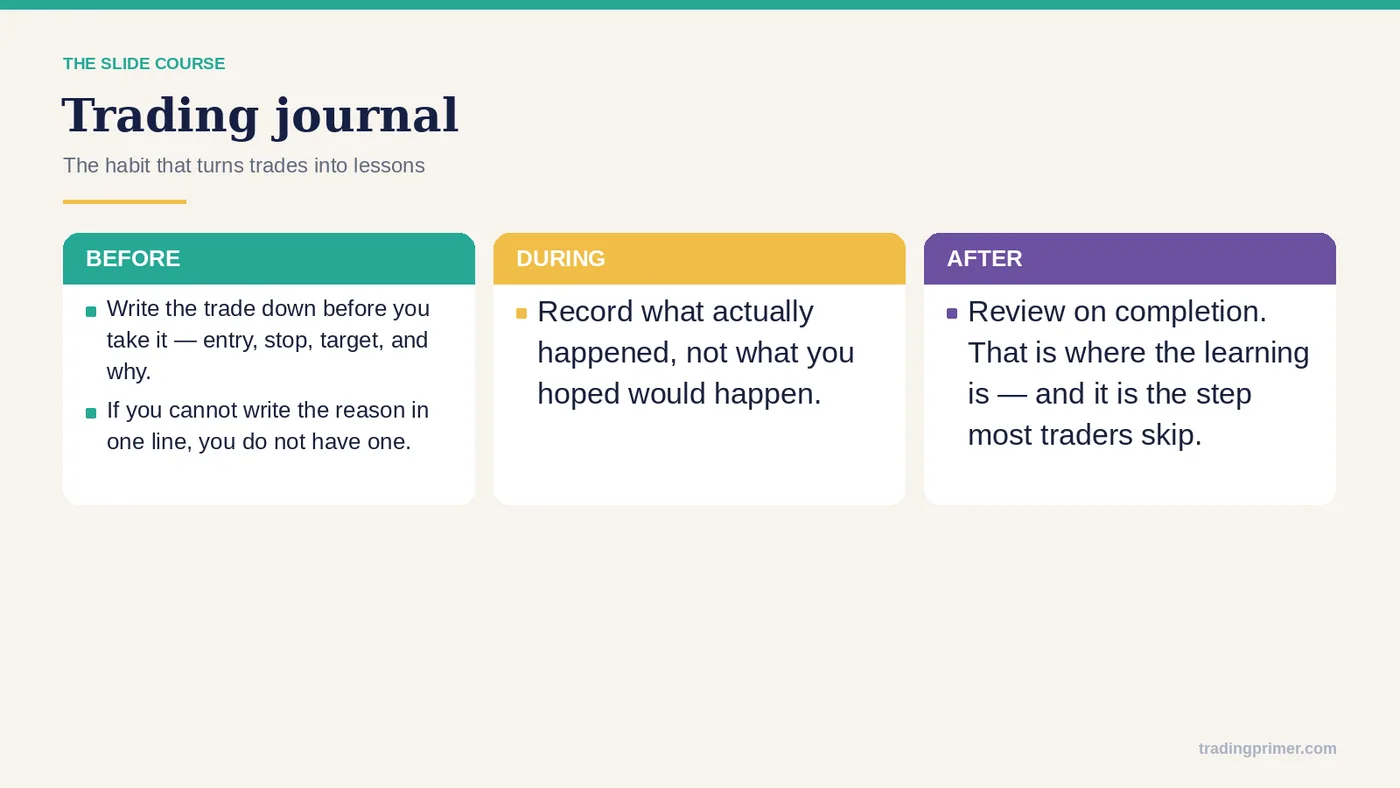
One autopsy describes a trade; twenty describe a trader. Do not change a rule on the strength of two or three diagnoses — wait until one category is clearly ahead of the others across roughly twenty losses, then work on that category alone for a month. Log the full trade, wins included, in the trading journal, so the autopsy has something to compare against.
What to do with the result
Paste the one-line verdict into the note of that trade in your journal. After ten autopsies the table below shows which category keeps coming back — that is the lesson to reread, and the only one. One category at a time; fixing five things at once fixes none.