Trade planner
Size, risk/reward, break-even win rate, liquidation distance and live funding cost — the five numbers professionals check, computed together, with a structure verdict before you press buy.
USE A LIVE PRICE
—
—
—
—
—
—
—
The Practice Arena opens this exact setup on live prices with a virtual $10,000 account — same coin, same direction, same stop, same target. Every position you close is written into your journal, so the number you learn from is your own.
carries the whole plan
The order professionals plan in
Risk first ($ you're willing to lose), then stop (where the idea is wrong), then size (derived — never chosen), then reward (is it worth it?), then structure (can leverage mechanics kill the plan before the idea plays out?). This screen forces that order. If you find yourself adjusting the stop to get a bigger size, you've reversed it — that's the sizing discipline failing in real time, and the honest fix is a smaller trade, not a nearer stop.
The structure check validates the container, not the idea: a plan can pass every check and still lose — that's trading. What a passing grade means is that the loss will be the planned 1%, not the account.
Common mistakes
Planning after entering. Every number here is cheap before the trade and expensive after. Ignoring the liquidation buffer: if your stop sits close to your liquidation price, slippage plus funding drift can convert a planned −1R into a total margin loss. Treating the verdict as a signal: it grades structure, never direction — direction is your job, and the journal is the only judge of that.
A worked example, and where leverage breaks it
The numbers from the course slide below, run through this planner. Account $15,000, risk 2% per trade (the slide’s example; our own default is 1%), so $300 is the most this trade may lose. Entry on Ether at $4,000, stop at $3,800 — 5% away. Size is derived, not chosen: $300 ÷ 5% = $6,000 of Ether, 1.5 ETH. Target $4,600 makes the ratio 1 : 3 and the profit if it works $900; break-even win rate 25%.
Leverage changes none of those numbers — it only changes how much margin you post. At 3× the margin is $2,000 and the estimated liquidation price (isolated margin, 0.5% maintenance) is about $4,000 × (1 − 1/3 + 0.005) ≈ $2,687, far below the stop. The stop does its job long before the exchange would.
At 20× the margin falls to $300 and the same estimate gives a liquidation price of about $4,000 × (1 − 1/20 + 0.005) = $3,820 — above the $3,800 stop. Price would liquidate the position before it ever reached the stop, so the planned $300 loss quietly becomes the whole margin plus fees, and the stop you placed never fires. This is the most common way a correctly sized trade still blows up, and it is the check the “liq. distance vs stop distance” line exists for.
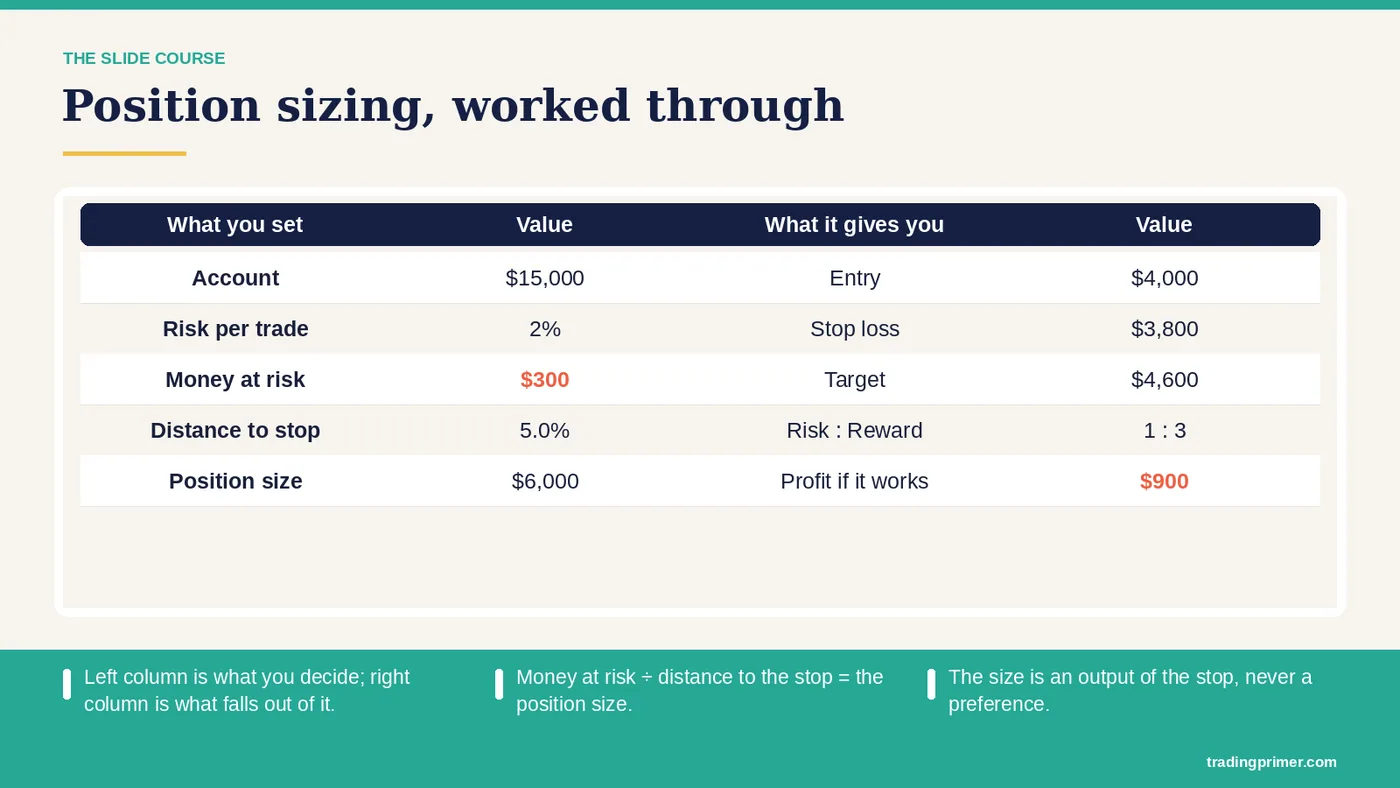
Rule of thumb from the example: the liquidation price should be further from entry than the stop by a wide margin. If the planner shows them close together, lower the leverage — the risk in dollars does not change, only the margin you post and the room you leave yourself.